
Tag: wildfly
-
Customizing application properties with JBoss EAP/Wildfly
Usually developers have to create and deploy different versions of their application: For local development, testing, training, production, … Different third-party and system dependencies for those different versions will preferably be configured via the container, e.g. data sources, JMS, topics, mail server, etc. However, most applications also contain several custom application properties such as the…
-
WildFly 8-10 and JBoss EAP 7 verbose HTTP headers
As a developer I am really happy to have an easy way to determine which version of a software I’m running. But I do not like it if my software tells everyone its name and version, as this gives important fingerprinting information to possible attackers. If you use WildFly versions 8 through 10 or JBoss…
-
ActiveMQ Confusion and What comes with your JBoss EAP / WildFly
Oftentimes people talk to each other about using ActiveMQ, but they’re actually referring to different brokers. That is because there are 3 different message brokers with ‘ActiveMQ’ in their name and this turns out to be pretty confusing when a project as big as WildFly starts to use a broker with ‘ActiveMQ’ in its name that is…
-
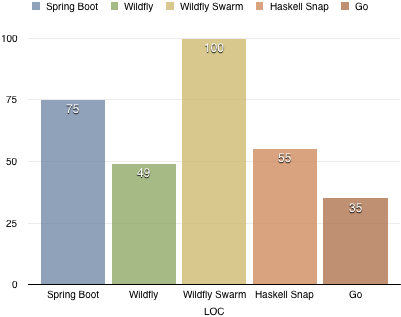
Measuring the Lightweightness of Go by Looking at a Simple Web Service
by
Inspired by my article The lightweightness of microservices – Comparing Spring Boot, WildFly Swarm, and Haskell Snap, a colleague of mine implemented the same Web service using the Go programming language. You can find his code here: Bitbucket-repo. To compare his implementations with the other ones, I integrated it into the main project (GitHub-repo) and measured it. Here…
-
The lightweightness of microservices – Comparing Spring Boot, WildFly Swarm, and Haskell Snap
by
Microservice should use lightweight frameworks. Lightweightness comes in different flavors. Here, I compare WildFly, WildFly Swarm, Spring Boot, and Haskell Snap as suitable lightweight frameworks.
-
JBoss EAP/WildFly configuration project
When developing applications using the JBoss EAP/WildFly application server there is a repetitive task that has been solved differently over and over again: The configuration of the application server, i.e. installing JDBC drivers, startup scripts, data sources, JMS destinations, logging categories, etc. Within our company there are several projects addressing this problem. In this post we’d…
-
Getting started with ELK and JBoss EAP6
In this post we will describe what is needed to get started with managing your EAP 6 logs with ElasticSearch, Logstash and Kibana. There are several reasons why you would want to collect your logging output in a central place. Aggregate (output from multiple applications / hosts) Correlate events in different systems Analyze (more than…
-
JBoss EAP / Wildfly – Three ways to invoke remote EJBs
by
The JBoss EAP / Wildfly application server provides as primary API the EJB client library to invoke remote EJB components. This client library is the implementation of the WildFly application server to invoke EJB components. The lookup of an object, such as a JMS connection factory, from the naming service is with the EJB client…
-
JBoss EAP / Wildfly Management Interfaces and Clients
by
The JBoss EAP / Wildfly provides a powerful concept for management, configuration, and monitoring of the application server itself and its Java EE applications. In the previous post we focused on some useful runtime metrics, which are of interest when monitoring your application server and applications. This post introduces the management clients provided by the…
-
Monitoring the JBoss EAP / Wildfly Application Server with the Command Line Interface (CLI)
by
The JBoss EAP / Wildfly provides a powerful concept for management, configuration and monitoring of the JBoss Application Server itself and its Java EE Applications. The concept is based on the detyped management API. All management clients of the application server use this detyped management API to interact with the server. In this post we…
You must be logged in to post a comment.